
History
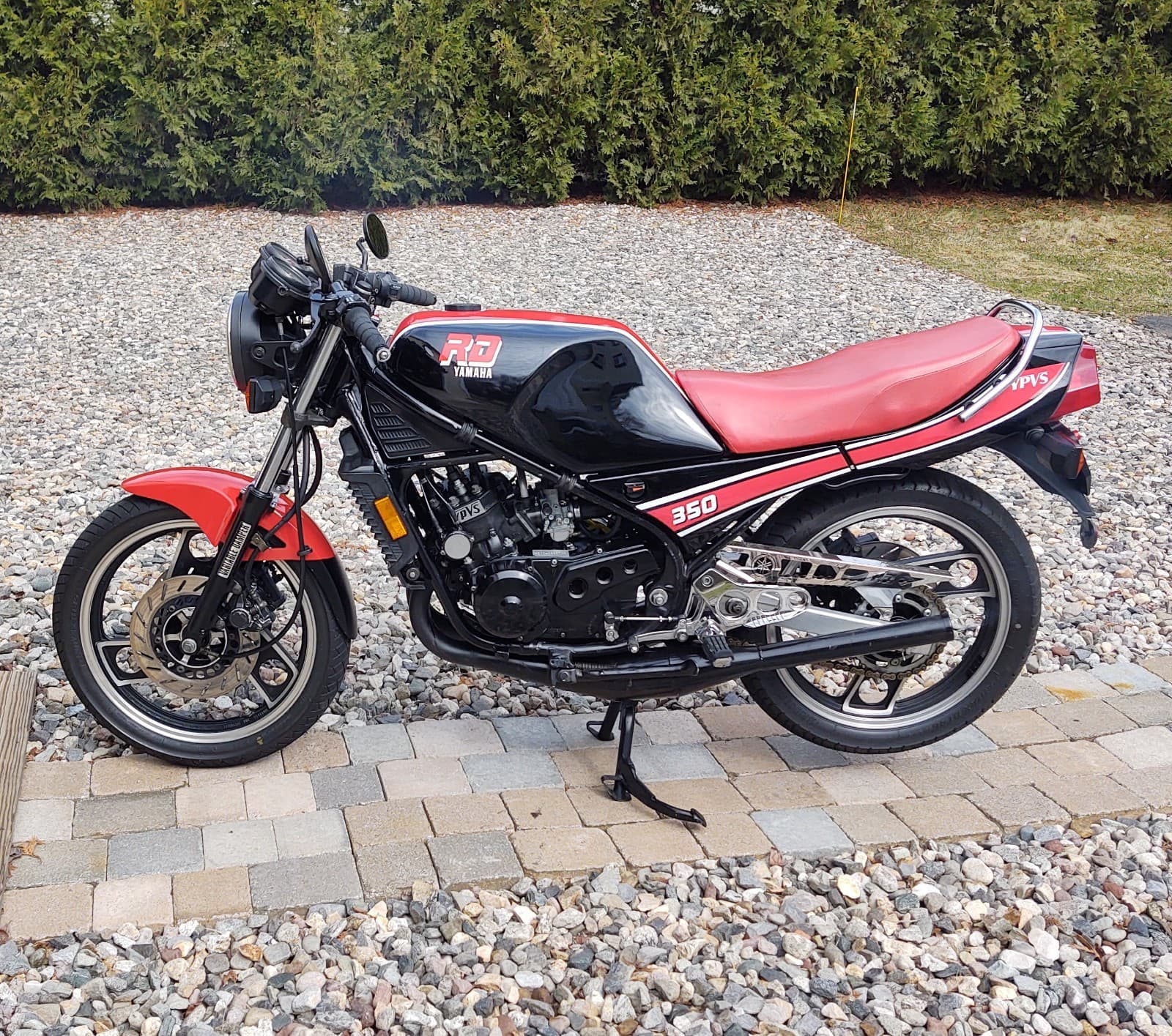
The RZ350 is the final development of Yamaha's RD lineage. Its direct predecessor, the RD350LC, ran from 1980 to 1983. The RZ350 kept the same 64×54mm bore and stroke but was otherwise a completely new machine — no shared parts with the LC series.
Yamaha introduced it as "the nearest thing to a road going racer ever produced." The key technology was the YPVS power valve. Kenny Roberts' works YZR500 used YPVS for the 1980 Grand Prix season, giving the road bike a concrete connection to Yamaha's racing program.
The family evolved under several names and specifications. That matters when shopping: a model name alone does not establish the market, equipment or originality of an individual bike.
US Market: Firsts, Frustrations, and Fast Exit
The American RZ350 was the first Yamaha street bike sold in the US with a perimeter frame. The frame rails run around the underside of the fuel tank, a layout described in the model's US-market history.
The US sales window was short. When evaluating an imported or modified example, establish what it is from its identification and paperwork rather than an advertised model year alone.
One concrete weight advantage over the competition: at 371 pounds, it was 66 pounds lighter than the Honda VF500 Interceptor, its primary rival.
The YPVS: Why It Matters
A conventional two-stroke faces an inherent contradiction: exhaust port timing that produces peak top-end power tends to kill low-RPM torque. The RZ350 addresses that tradeoff with a variable exhaust-port valve, the Yamaha Power Valve System.
Extracting similar output from a fixed-port engine would have required sacrificing substantial bottom- and mid-range performance. The YPVS lets the engine behave tractably at low revs and make proper power higher up. Claimed output is 59.1 PS at 9,000 rpm, with 35.8 Nm of torque at 8,500 rpm. The engine is a parallel twin two-stroke with reed valve induction, a 6.0:1 compression ratio, and a six-speed gearbox.
Global Variants
The later YPVS-equipped machines were sold as the RZ350 in markets including the US and Australia; RD350 YPVS is another name in this model family. The RD350 YPVS history records Japanese production from 1983 to 1986, replacement by the F2 in 1986, and Brazilian RD350R production from 1992 to 1995.
Treat those names as a starting point, not proof that every component interchanges. Check the frame and engine identification, registration documents and equipment on the actual bike. If originality matters, ask for records and photographs of changes.
Ownership and Maintenance
The RZ350's parts situation is better than you'd expect for a 40-year-old two-stroke. Many major engine components interchange with the Yamaha Banshee ATV. That connection makes the Banshee aftermarket relevant to an RZ350 search. Verify the exact part and application before buying; a shared engine family is not a promise that every component fits.
If you want more displacement, an Athena big-bore kit takes the RZ350/Banshee to 68mm/392cc, though RZ350 installation eliminates the power valves and requires a modified spigot-type exhaust. That's a meaningful tradeoff on a bike defined by its power valve.
What to Check Before Buying
YPVS servo and controller — check this first. Turn the ignition on and listen: you should hear the servo cycle the power valves. An owner discussion describes noisy servo failures or little or no valve rotation. If the valves are gummed up from long storage, they can prevent the servo from cycling at all. On the controller side, a controller-repair discussion identifies output transistors as a possible failure point. A non-functional YPVS isn't an automatic deal-breaker, but it must be priced into the deal.
Water pump seal. Owners report water pump seal problems and sticky power valves. These are reports worth asking about, not proof that every example has the same faults. Ask what cooling-system work has been done and have any unexplained fluid loss or contamination investigated before purchase.
Crank seals and compression. An RZ350 owner discussion recommends checking crank seals and plug condition for signs of lean running. A leakdown test is recommended in this RZ350 discussion. Ask a mechanic familiar with two-strokes to assess any questionable example.
Carburetors and air leaks. Wiggle the carb and intake manifold — there should be no play; it should be tight and snug. A service article identifies a stuck float needle as a possible carburetor problem. Let the condition and service records determine what work to budget for.
Electrical. An owner discussion points to the spark plug caps as something to investigate when sputtering or bogging seems like a CDI problem. Check the bike's electrical functions and establish the cause of a fault rather than assuming a diagnosis.
Frame and tank. Scan the frame for cracks or stress marks near engine mounts. One auction condition report notes minor rust in the tank. Inspect the tank on the actual bike rather than assuming its condition.
Cooling system. Inspect the radiator, hoses and coolant condition, and ask about leaks or overheating. If something looks wrong, establish the cause rather than accepting an unsupported diagnosis from the seller.
Who Should Buy One
The RZ350 makes sense for a rider who wants a rare piece of two-stroke history that is still rideable, tunable, and supported by a real aftermarket. It was one of the most successful club racing bikes of the 1980s and offered real performance for the money — the combination of a usable powerband and legitimate GP-derived hardware hasn't gotten less interesting with age.
It does not make sense for someone who wants a low-maintenance commuter, doesn't want to learn two-stroke specifics, or expects to find a clean unmolested example without effort. Check YPVS function and the cooling system carefully. If either has a known fault, establish what the repair involves before deciding whether to buy.
If the YPVS is working, the water pump seal is sound, and the compression numbers check out, the RZ350 rewards ownership in ways that nothing else street-legal from that era quite matches.