
History
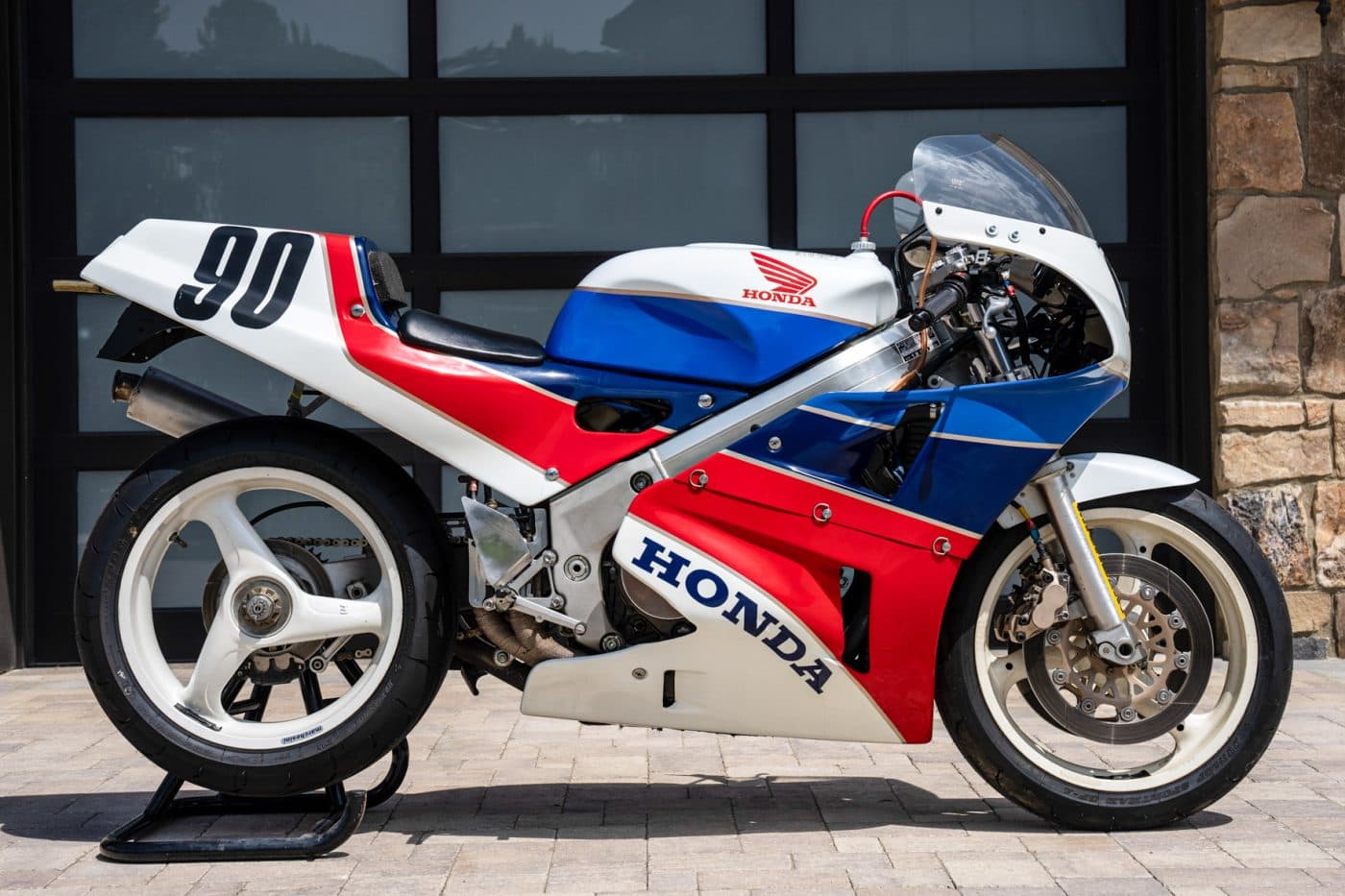
The Honda VFR750R — factory code RC30 — wasn't built to sell motorcycles. It was built to win races, specifically to satisfy the homologation requirements of the newly formed World Superbike Championship that began in 1988. Based on Honda's RVF750 endurance and TTF1 racers, the RC30 was an exercise in getting a factory race machine past the scrutineers with headlights attached.
Honda announced the bike in July 1987. Despite sharing the same 748cc bore and stroke as the standard VFR750F Interceptor, the RC30 shared almost no parts with it — the design started from a clean sheet. The clutch, gearbox, crankshaft, oil pump, connecting rods, water pump, pistons, valvetrain and cylinder heads are all specific to the RC30. Each machine was hand-built at Honda's Hamamatsu plant alongside the actual GP bikes, at a rate of 60 per week.
The engine made no apologies for what it was. The liquid-cooled 748cc 90-degree V4 used titanium connecting rods and gear-driven double overhead cams, with two-ring pistons to cut reciprocating mass. It was the first mass-produced motorcycle to use titanium connecting rods. The 360-degree crankshaft gave it a firing character entirely different from the standard VFR's 180-degree arrangement. Carburettion was four 38mm Keihin CVs with an 11.0:1 compression ratio. The V4 engine and aluminum twin-spar frame were essentially carry-overs from the RVF endurance racer, detuned roughly 30 horsepower for street use.
The chassis matched the ambition of the engine. The RC30 came with a close-ratio six-speed gearbox, a slipper clutch, an aluminum twin-spar frame, and adjustable Showa suspension. Braking came from dual 310mm floating discs with four-piston Nissin calipers at the front and a 220mm rotor at the rear. The single-sided Pro-Arm swingarm — originally developed by the Elf 500cc GP team under Honda patents — wasn't there to look good in dealerships. It was there to make rear-wheel swaps faster in the pits. The bike also carried a Pro Squat Rear Brake Linkage connecting the rear caliper to the frame via a rose-jointed linkage through the swingarm to reduce rear wheel hop under braking.
On track, it delivered immediately. The 1988 Superbike World Championship was the inaugural season; Fred Merkel won the riders' title and Honda took the manufacturers' championship. In 1988 Merkel took two race wins and three podiums; in 1989 he took three wins and seven podiums to win the title again from Stéphane Mertens and Raymond Roche — all while the RC30 was not particularly reliable. Carl Fogarty won the F1 Championship on one, and Steve Hislop used it to record the first 120mph TT lap in 1989.
By 1994 Ducati's V-twins had made the RC30 obsolete. Honda redesigned the RC30 around more technology from the RVF endurance racer and released the RC45, though it took three seasons to win its one WSB title, with John Kocinski.
Markets and Variants
Honda built roughly 3,000 examples worldwide between 1987 and 1990, releasing first to Japan in 1987, then Europe in 1988, then the United States in 1990. Note: Bennetts BikeSocial cites "almost 5,000" RC30s built, while other sources give approximately 3,000. Treat the precise total as uncertain.
Market differences matter significantly when buying. The first 1,000 units went to Japan, severely detuned to 77 horsepower with smaller-diameter headlights and black mirrors. That initial batch was sufficient to complete WSB homologation for 1988. Japanese-spec power was 77ps at 9,500rpm; some export markets received versions with up to 135ps at 12,500rpm.
| Model Year | Market | Key Differences | |---|---|---| | 1988 VFR750R-J | Japan | Small headlights, black mirrors, yellow Honda wing logo, engine no. starting RC07E | | 1989 VFR750R-K | Japan | Same spec as J; valve seat material changed during this run | | 1988–1989 | UK/Europe | Larger headlights, white mirrors, gold-anodised wheels | | 1990 | USA (49-state) | ~86hp, "0" in eighth VIN position, white wheels |
North American models received white wheels; European and Australian models received gold-anodised Comstar wheels. British models have larger diameter headlights and mirrors finished in white. Confirm the market of origin against the VIN, wheel colour, headlight diameter and mirror finish — spec changed very little between years but variations between markets are real.
HRC offered a full race kit — cams, close-ratio gears, carbs, exhaust — that transformed the base bike into a genuine works-replica. Documentation confirming a kit fitment changes a bike's provenance and value meaningfully.
Ownership and Maintenance
The RC30 is expensive to own correctly. Spares are scarce and factory bodywork, fabricated from fibre-reinforced polymer, is extremely difficult to source as a replacement. The 18-inch rear wheel restricts modern tyre choices. Honda has launched a factory Refresh Plan for the 1987–90 VFR750R, acknowledging the bike's importance to its motorsport history, though parts availability through that programme should be verified independently.
The engine demands patience at cold starts. Piston tolerances are racing-tight, so let the motor warm thoroughly before opening the throttle. Cold seizures were a known problem in period, and valves could stretch if the bike was worked hard before reaching operating temperature. Monitor oil level routinely — the single compression ring and single oil scraper ring setup means RCs can consume oil.
What to Check Before Buying
Inlet valves and seats: Some early RC30s suffered premature valve seat wear due to mismatched valve and seat materials. Honda updated the material during the R-K production run but has not disclosed the exact changeover point. A compression test and valve clearance check are essential on any low-mileage early bike that may never have had the seats addressed.
Brake discs: The lightweight discs were prone to warping under road use. Check for pulsing under braking and measure disc thickness and runout.
Front mudguard: Early J and K models are known to rub the front mudguard against the fairing under heavy braking. A modified guard resolved the issue on the L-model. Inspect the guard and inner fairing for contact marks.
Race history and crash damage: Inspect behind the fairings for crash repairs — many RC30s were raced hard. Stripped or replaced fasteners, mismatched paint on the frame, and repaired subframe tabs are the indicators. A bike missing original parts is worth less unless it carries documented HRC kit components.
Originality of key components: Confirm gear-driven camshafts (chain-driven cams belong to a different Honda V4 entirely), the single-sided Pro-Arm swingarm, and correct wheel colour for the stated market. Almost 5,000 RC30s were built but only a fraction reached the UK, so many bikes for sale are grey imports — not a problem in itself, but the spec must match the claimed origin.
HRC kit documentation: The full HRC race kit materially changes the bike's provenance. If the seller claims kit fitment, ask for the original documentation. Undocumented modifications are worth nothing over stock.
Who Should Buy One
The RC30 is for the collector or serious enthusiast who understands that buying one is the beginning of an ongoing financial commitment, not the end of it. Parts are scarce. Correct factory specification matters enormously to value. The street version was effectively a racing credential with headlights — which means it rewards the owner who treats it like one.
If you want an unmolested, numbers-matching example with its original bodywork intact, buy the most original bike you can find regardless of mileage, then verify everything. If you are after a rider rather than a museum piece, a correctly specced bike with some honest mileage and documented maintenance is preferable to a low-mileage machine that has sat cold for a decade and may have developed the valve seat issues the early engines are known for.
This is not a beginner's collector bike and it is not cheap to run correctly. It is, however, one of the most significant production motorcycles of the late twentieth century — the machine that defined what WSB homologation could look like and won the first two World Superbike titles back to back. That matters, and so does buying the right one.